


The Untold History of North-East India : Cultural Stories You’ve Never Heard
Lying far beyond the bustling cities of India and in the hills shrouded by mist and the verdant valleys, the Northeast is the land replete with tales of courage, cultural brilliance, and subtle endurance that finds little mention in the mainstream lineup, waiting to be explored. From its hard-fought victories over great empires to its distinct festivals echoing through forested hills, Northeast India, the land of seven sisters namely Assam, Arunachal Pradesh, Manipur, Meghalaya, Mizoram, Nagaland, and Tripura along with Sikkim, remains a canvas of histories and traditions yearning to be embraced in all its glory.
In the seventeenth century, Assam was at a crossroads as the mighty Mughal Empire was attempting to expand into the Ahom kingdom. It was at the Battle of Saraighat in 1671 that the spirit and valor of this land defiantly shined through. At the helm was Lachit Barphukan, the legendary Ahom general who stood up against adversity when his own forces were vastly outnumbered. By transforming the mighty Brahmaputra River into a battlefield of resistance, he brilliantly crafted naval tactics to lead his men to a victory that secured the sovereignty of Assam.
This spirit of resistance permeated further, manifesting in various forms across different kingdoms. The Manipur kingdom, with its sophisticated court culture and robust military traditions, proved another bulwark against foreign invasion. The legendary Bir Tikendrajit Singh, crown prince of Manipur, symbolized this sentiment during the late nineteenth century. He contributed greatly with his exceptional military acumen to the modernization of Manipur's army while also maintaining the kingdom's traditional values and independence. The Anglo-Manipur War of 1891 marked the culmination of his efforts, wherein the Battle of Khongjom showcased the indomitable spirit of the Manipuri people. Though ultimately defeated, Tikendrajit's sacrifice and subsequent execution by the British transformed him into a martyr whose legacy continues to inspire generations of Manipuris.
The colonial period witnessed the emergence of remarkable freedom fighters who carried forward this tradition of selfless sacrifice for the motherland. Rani Gaidinliu, legendary Naga spiritual leader who was merely 16 at that time, led the Heraka Movement against British rule, which gained great momentum under her influence. Recognizing her dedication, even Mahatma Gandhi called her "Daughter of the Hills." Her decades-long struggle, which included incarceration, demonstrated how the Northeast's resistance movement connected with India's broader independence struggle while maintaining its own distinctiveness.

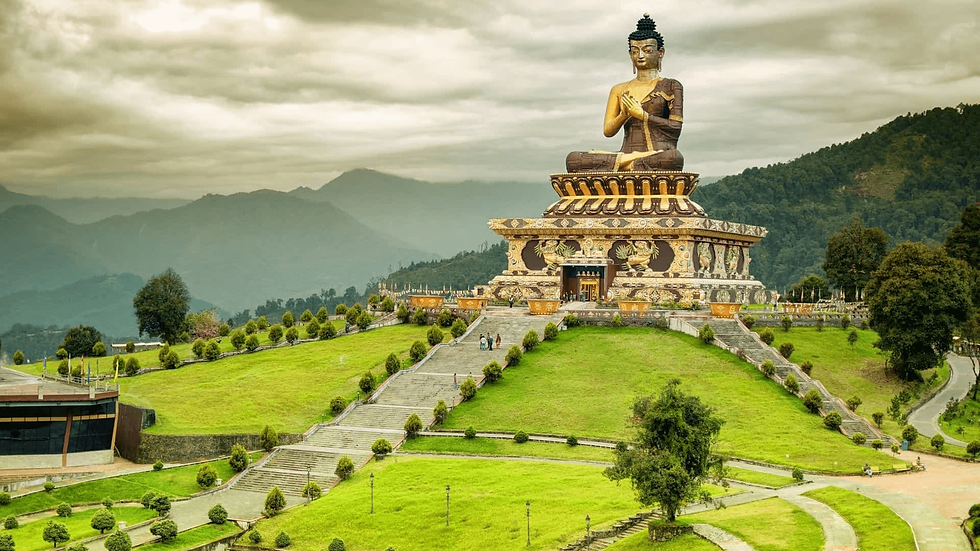
These historical struggles unfolded against a backdrop of extraordinary natural beauty that has profoundly impacted the region's cultural development. The tea gardens of Assam, where the Ahom kings once held court, and the pristine lakes of Manipur, witness to Tikendrajit's bravery, mirror the azure sky in perfect tranquility. The snow-capped peaks of Sikkim rise majestically against pure blue skies, and the cascading waterfalls of Meghalaya plunge through moss-covered cliffs into hidden gorges. This landscape has not only nurtured legendary figures but also shaped unique cultural expressions that reflect the region's historical experiences.
The region is home to over 200 tribes, each with its distinct traditions, dialects, and crafts that form a vibrant fabric of diversity. Festivals like Bihu in Assam celebrate the harvest and the spirit of renewal, while Cheraw, the bamboo dance of Mizoram, displays precision and community coordination. In Meghalaya, the Wangala festival of the Garo tribe showcases the beating of 100 drums, transforming the hills into a living rhythm of celebration. Manipur's martial art, Thang-Ta, combines sword and spear techniques with philosophical principles. Similarly, in Nagaland, the Hornbill Festival, 'The Festival of Festivals', preserves ancient traditions while adapting to modern contexts like promoting inter-tribal interactions and harmony.
The region's religious and spiritual heritage also bears the imprint of its historical struggles. Arunachal Pradesh's Tawang Monastery, the largest Buddhist monastery in India and birthplace of the sixth Dalai Lama, has preserved invaluable knowledge about Tibetan Buddhism and Himalayan culture, serving as a cultural bridge between India and Tibet. The monastery is also famous for its ancient manuscripts and thangka paintings.
The region's artistic heritage is reflected through textile traditions such as Assam's Muga and Eri silks, which are world-renowned for their natural sheen, while Nagaland's vibrant shawls and beadwork communicate tribal identity and heritage with every motif. In Manipur, the handwoven Phanek and Moirang Phee textiles are cultural emblems passed down through generations, and Arunachal Pradesh's bamboo crafts exemplify sustainable artistry deeply rooted in nature. In Meghalaya, the Khasi people have preserved their matrilineal society, where women hold central positions in family and social structures.
The living root bridges of Cherrapunji, crafted by the Khasi and Jaintia tribes using the aerial roots of rubber trees, represent an extraordinary example of sustainable engineering that has sustained communities for over 500 years. The Loktak Lake in Manipur, with its floating phumdis and the unique Sangai deer or the 'Dancing Deer', supports unique ecosystems and livelihoods, while the grasslands of Kaziranga National Park stand as a conservation success story, protecting the one-horned rhinoceros amid thriving biodiversity.
These stories and practices highlight the significance of the Northeastern region in the larger Indian narrative, though scarcely recognized. Today, Northeast India's historical legacy continues to shape its identity and aspirations. The region's strategic importance as India's gateway to Southeast Asia echoes its historical role as a crossroads of civilizations.
The challenge now lies in preserving the delicate balance between honoring this rich historical heritage and embracing modernization. From Lachit Barphukan's strategic brilliance to Rani Gaidinliu's unwavering courage, from Tikendrajit Singh's sacrifice to the Khasi people's environmental stewardship, the Northeast's history offers valuable lessons for contemporary India about resistance, adaptation, and the preservation of cultural identity in the face of overwhelming change.


Trong quá trình theo dõi cách nhiều nền tảng giải trí trực tuyến phát triển hệ thống, hm88 mang đến cảm giác khá chỉn chu ngay từ lần đầu quan sát. Mình có ấn tượng ban đầu rằng bố cục được sắp xếp hợp lý, các khu vực như thể thao, casino trực tuyến, bắn cá và nổ hũ được phân chia theo từng nhóm nên việc tìm kiếm diễn ra thuận tiện hơn. Khi chuyển qua từng danh mục, mình không mất nhiều thời gian để làm quen vì vị trí các chức năng khá rõ ràng. Trong lúc trải nghiệm thử casino trực tuyến và thể thao, tốc độ phản hồi tương đối ổn định, thao tác chuyển đổi…
Trong lần trải nghiệm gần đây với F8bet, mình nhận thấy giao diện được xây dựng theo hướng ưu tiên khả năng quan sát khi các nhóm chức năng được tách thành từng phần riêng biệt. Thể thao, casino live, game bài, xổ số và bắn cá đều có cách hiển thị thống nhất, giúp việc theo dõi trở nên trực quan hơn. Mình thấy cách sắp xếp này hỗ trợ giảm thao tác tìm kiếm và tạo cảm giác dễ làm quen ngay từ những lần truy cập đầu tiên. Trong quá trình sử dụng, hệ thống vận hành ổn định và phản hồi khá nhanh giữa các chuyên mục
Một điểm mình để ý khi xem lucky88 là cách nền tảng mở rộng nhiều danh mục nhưng vẫn giữ bố cục khá rõ ràng. Người dùng có thể tiếp cận các nội dung như thể thao, game bài, nổ hũ hoặc casino trực tiếp trong cùng một hệ sinh thái. Điều đáng chú ý là mỗi khu vực đều có không gian hiển thị riêng nên không bị chồng chéo quá nhiều. Theo mình, đây là cách tổ chức phù hợp với hệ thống có nhiều nội dung.
Trong lúc tìm hiểu Bet88 , điều mình muốn xem là khả năng duy trì tốc độ truy cập ở nhiều danh mục khác nhau. Sau khi quan sát, mình nhận thấy việc chuyển từ khu vực bắn cá sang game bài hoặc thể thao diễn ra khá mượt. Mình cũng chú ý đến các trò chơi từ JILI và CQ9 khi xuất hiện tương đối nổi bật trên giao diện. Dưới góc độ phân tích, tốc độ xử lý ổn định là yếu tố giúp người dùng dễ duy trì trải nghiệm trong thời gian dài.
Điều mình muốn kiểm tra ở GO99 là khả năng kết nối giữa các chuyên mục. Sau khi xem qua casino, thể thao, game bài và bắn cá, mình thấy các khu vực được tổ chức theo cùng một logic điều hướng. Dù nội dung khác nhau nhưng cách bố trí vẫn giữ sự thống nhất, giúp người dùng không phải làm quen lại mỗi khi chuyển sang một sảnh khác.